 Download PDF
Contents
Overview of Galamsey and Environmental Destruction in Ghana
Multimodal and Networked Rhetoric as Drivers of Participation in Digital Environmental Activism
Analysis: Multimodal Strategies and Social Media Amplification
Example 1: The Polluted River Bodies–A Multimodal Call to Action
Cultural Authority and Moral Legitimacy: The Asantehene’s Intervention
Cultural Authority and Moral Legitimacy: The Asantehene’s Intervention
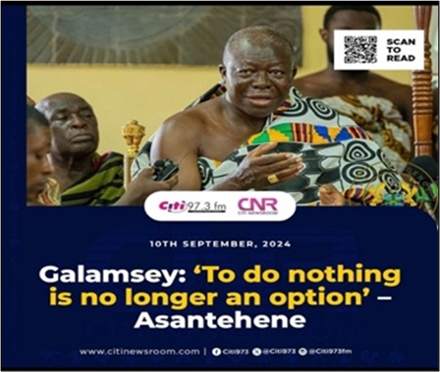
Figure 6 depicts the Asantehene, Otumfuo Osei Tutu II, publicly condemning the destruction of Ghana’s rivers through illegal mining. Circulated widely through video clips, images, and captioned posts, this intervention resonated across digital publics because it drew on a form of authority that extends beyond regional leadership into national moral discourse. As Ray (1996) explains, traditional authority in Ghana is grounded in long-standing systems of ancestral governance that continue to shape ethical judgment and public legitimacy alongside the modern state. The Asantehene's intervention, therefore, carried moral weight that rendered environmental destruction immediately legible as an ethical failure rather than merely a regulatory or economic problem. Importantly, this moment did not stand alone but interacted with the emotional circulation of polluted river images already shaping public discourse.
Against this backdrop, the rhetorical force of the Asantehene’s condemnation becomes clearer. Images of contaminated rivers had already generated collective grief over loss, anger at neglect, fear for health and livelihood, and shame associated with cultural desecration. The Asantehene’s words did not introduce new emotional responses; rather, they validated and clarified those already in circulation. By publicly naming illegal mining as a wicked affront to Ghana’s ancestral heritage, he transformed affective reactions into moral interpretation. As Papacharissi (2015) notes, culturally authoritative voices within networked publics can stabilize emotional meaning by affirming which responses are justified and worthy of public action.
This moral framing draws its persuasive strength from Akan cultural understandings of leadership and environmental stewardship. Within Akan society, the Asantehene is widely recognized as the custodian of the Golden Stool, a sacred symbol representing the collective soul and continuity of the Ashanti people, anchoring his authority in ancestral legitimacy rather than state power (Ray, 1996). Traditional leadership in this context is closely associated with stewardship of land, water, and communal wellbeing, reflecting indigenous systems of environmental responsibility and moral governance (Yelsang & Millar, 2013). Rivers such as the Pra, Offin, and Oda, which flow through Ashanti territory, are embedded in local cosmologies as sacred spaces connected to ancestral spirits, and their pollution signifies a rupture in the moral and spiritual order governing community life (Yelsang & Millar, 2013). When the Asantehene addressed galamsey, his message recontextualized polluted river images as evidence of a deeper ethical failure, giving cultural language to the shame already circulating through the visuals and naming environmental destruction as a violation of sacred obligation rather than an unfortunate consequence of economic activity (Gries, 2017).
As the Asantehene’s statements circulated across digital platforms, they were frequently referenced in protests, online commentary, and advocacy posts, often appearing alongside images of environmental destruction caused by illegal mining. This uptake illustrates how cultural authority can convert emotional response into civic orientation. Voices carrying this level of legitimacy can reshape public engagement by redefining what counts as ethical action and who bears responsibility for enacting change, particularly within movements grounded in shared values (Middleton et al., 2015). Importantly, the Asantehene’s intervention did not replace grassroots activism but reinforced it, lending moral legitimacy to civic participation across class, regional, and generational lines. As Tufekci (2013) argues, digital movements gain durability when emotional appeals are anchored in trusted sources that audiences recognize as ethically credible. Taken together, the Asantehene’s intervention amplified rather than displaced the emotional work performed by polluted river imagery, demonstrating how digital activism can translate emotion into sustained civic action when visual evidence of harm is reinforced by indigenous systems of authority, memory, and responsibility.