 Download PDF
Contents
Overview of Galamsey and Environmental Destruction in Ghana
Multimodal and Networked Rhetoric as Drivers of Participation in Digital Environmental Activism
Analysis: Multimodal Strategies and Social Media Amplification
Example 1: The Polluted River Bodies–A Multimodal Call to Action
Cultural Authority and Moral Legitimacy: The Asantehene’s Intervention
Example 1: The Polluted River Bodies–A Multimodal Call to Action
All images analyzed in this study were collected from publicly accessible posts on X (formerly Twitter) and Instagram under the hashtag #StopGalamseyNow between September and October 2024. Images were archived and analyzed as circulating multimodal artifacts rather than as isolated posts. The analysis focuses on circulation, uptake, and affective resonance rather than authorship attribution. Images are reproduced under fair use for purposes of scholarly arguments.
The viral images of Ghana’s polluted rivers circulating under the StopGalamseyNow hashtag function as powerful multimodal texts that communicate more than ecological damage. For instance, the visibly discolored and sediment-filled waters in the Ankobra River (see Figure 1) and the Tano River (see Figure 2) illustrate the extent of contamination caused by illegal mining.
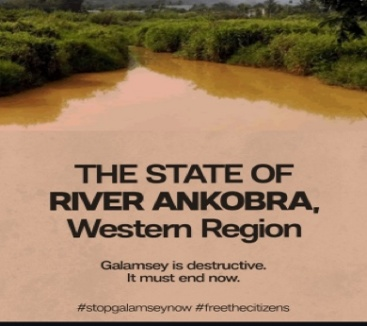
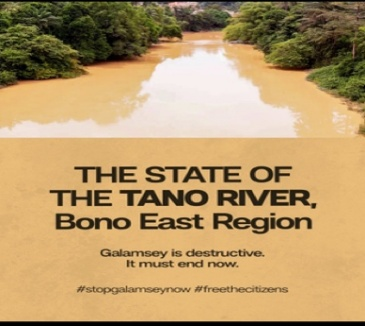
Similarly, the degraded landscapes surrounding the Birem River (see Figure 3) and Pra River (see Figures 4 and 5) visually foreground environmental destruction as both immediate and severe. These images expose a profound cultural and spiritual rupture rooted in Ghanaian worldviews.
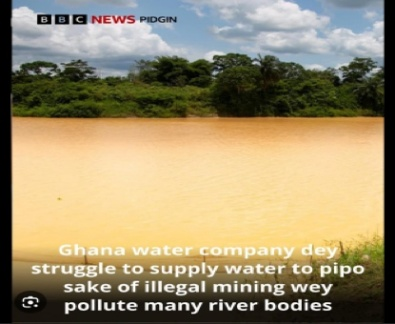
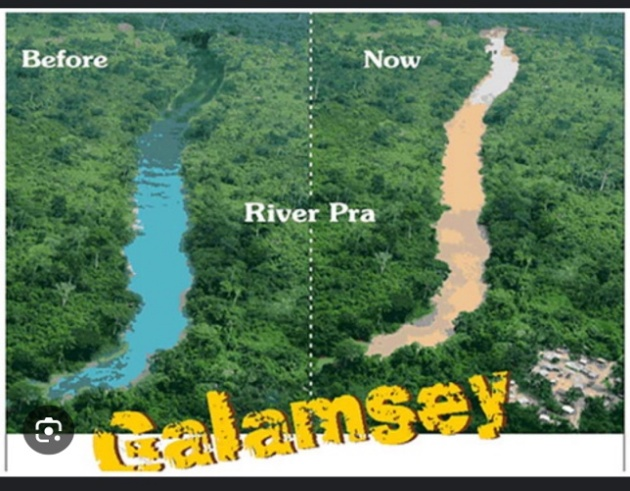
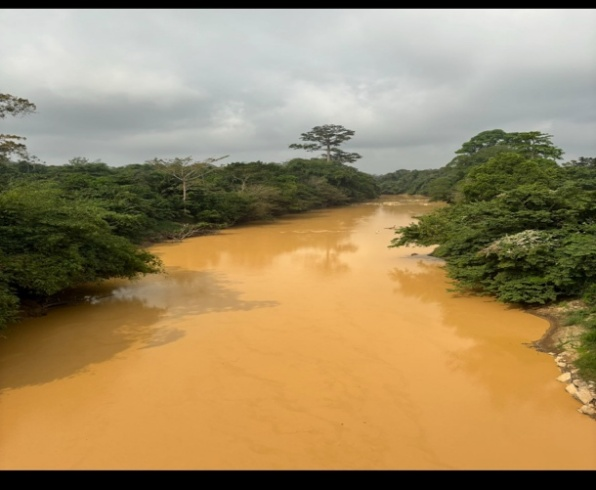
In Ghanaian traditions, rivers such as the Pra, Ankobra, Tano, and Birim are understood as sacred entities inhabited by river gods and ancestral spirits, shaping ritual practices, communal identity, and social cohesion, as documented in studies of indigenous environmental knowledge in Ghana by Yelsang and Millar (2013). At the same time, these rivers structure everyday life by providing drinking water, supporting agriculture, and organizing settlement patterns and social relations, thereby creating a material dependence (Koffi et al. 2017). When illegal mining contaminates these waters, the damage therefore exceeds ecological degradation and signals the violation of a moral relationship between communities and the land. What is disrupted is not only environmental balance but an ancestral covenant that binds people to cultural heritage and systems of responsibility. Within this cultural context, the emotional impact of these images is layered and rhetorically consequential. Rather than producing a single emotional response, the visuals evoke grief, anger, fear, and shame, each shaping how audiences interpret the crisis and their ethical position within it.
Grief emerges through the visible loss of clean water and fertile land; as seen in the murky, unusable river conditions depicted in Figures 1 and 4 reframing rivers once associated with sustenance and spiritual guidance as sites of collective mourning. This grief extends beyond material loss to reflect declining trust in institutions tasked with environmental protection and public welfare. As Papacharissi (2015) explains, shared grief within networked publics can function as an affective connective force that sustains engagement by enabling dispersed audiences to recognize common harm and identify with one another.
Closely connected to this grief is anger, which arises as a response to perceived injustice and betrayal. The stark visual contrast between polluted and once-viable river systems in Figures 2 and 3 makes regulatory failure and state inaction visible, directing public frustration toward identifiable systems of power rather than abstract causes. This anger becomes rhetorically productive because it assigns responsibility and legitimizes protest by framing environmental destruction as the result of human decisions rather than natural inevitability. With this affective dynamic in mind, Tufekci (2013) argues that digital activism shows how anger, when circulated through visual media, can lower participation thresholds by transforming outrage into a catalyst for collective response, particularly in networked environments where sharing itself becomes a political act.
Alongside anger, fear operates as a forward-looking emotion tied to uncertainty about health, livelihood, and generational survival. The visibly contaminated waters and surrounding degraded environments in Figures 4 and 5 evoke anxiety about long-term illness, food insecurity, and environmental collapse, particularly for communities dependent on river water for drinking and farming. This fear heightens urgency by framing environmental harm as an immediate and ongoing threat rather than a distant risk. The study on multimodal persuasion (Kjeldsen & Hess, 2021) indicates that fear-based appeals are most effective when grounded in concrete visual evidence and paired with collective pathways for response, rather than individualized blame or paralysis.
Shame functions as a deeply moral and culturally specific emotion connected to the desecration of spaces regarded as sacred. In Ghanaian cosmologies, rivers are embedded within ancestral systems of stewardship, and their pollution signals a failure to uphold communal obligations to both past and future generations. Shame in this context is not individualized guilt but collective moral reckoning, compelling audiences to restore dignity and reclaim ethical responsibility for the land. As images of polluted rivers recur across platforms, shame intensifies through repetition, transforming visual evidence into shared symbols of ethical failure and obligation within public discourse (Gries, 2017).
Through their composition and circulation, these multimodal texts enable emotion to move beyond affective response toward civic action. The pairing of images with captions, hashtags, and spatial framing reframes environmental destruction as an ethical imperative rather than a technical policy issue. As images are reshared, remixed, and recontextualized across platforms, their meaning evolves through public engagement, inviting interpretation, identification, and response. In this process, individual emotions are gradually converted into shared responsibility, encouraging protest, petition signing, content creation, and collective advocacy.
The result is not merely heightened awareness but sustained participation. Ordinary citizens increasingly take on active roles in amplifying overlooked injustices and mobilizing civic energy across dispersed publics, a process that Tufekci (2013) describes as networked issue entrepreneurship. In the StopGalamseyNow campaign, multimodal texts convert grief, anger, fear, and shame into shared catalysts for action, urging communities to protect not only their water and land but also their ancestral legacy and collective future.