
Hear, Tell, Live: Revisiting Storytelling in Technical & Professional Communication
by Elizabeth Caravella and Elizabeth Martynova | Xchanges 21.1, Fall 2026
Stories We Tell: The Student Experience (Student Written)
As a student my TPC and digital authoring journey began in the first and second years of my professional writing degree, when I took foundational courses such as Fundamentals of Editing, Introduction to Digital Authoring, and Ethics. In these courses my classmates and I developed core skills for communicating with various audiences in digital spaces. We learned this through projects that required us to remediate texts (often we had to take a text written in dense academic language and rework it for a different audience through digital means), as well as create instructions and guides. Those projects asked to consider how to communicate information in the most accessible and engaging manner, thus illustrating how people-centric TPC is as a practice, and the role of those in TPC as communicators and agents of change.
While the work I was doing prior to this course demonstrated how to be an effective communicator, the project discussed here taught me a new way of ensuring not only that I am reaching my audience but also that I am accurately representing the breadth of human experience and impact related to my chosen concern. In my Intermediate Digital Authoring class, my classmates and I were asked to create a ten-minute digital story in video format on a TPC topic of our choice. This meant that we had to choose a topic we could discuss meaningfully for that length of time, and which we could accurately represent utilizing the five modes: linguistic, visual, audio, gestural, and spatial (New London Group, 2000). In the following sections I discuss how I came up with the idea for my digital story; the process I went through in learning not only how to craft my story, but also the different ways stories can be crafted to best represent the people involved; and finally, the process of storytelling as a practice that happened with and among other students as I navigated this assignment alongside, and with constant feedback from, my peers. I hope to show readers the importance of storytelling in TPC pedagogy as a way to teach students how to better reach audiences, uplift underrepresented voices, and address issues of diversity, equity, and inclusion in TPC.
How it Started
When my classmates and I arrived for our first day of class, we received instructions for both our final digital story and the first touchstone: the pitch and pitch card. Receiving all of this information on the first day prompted us to start considering the content and format of our digital stories. I remember the first time I heard the word “story.” My mind immediately jumped to my preconception of stories as those typically seen in fiction or memoirs: singular stories that follow a linear pattern of beginning, middle, and end. I then began to consider all the linear stories in my life, thinking that I would pick something that happened to me and create a video about that.
What my classmates and I soon learned is that there were no expectations to create a linear story. Instead, we had the freedom to tell the particular kinds of stories we cared about in the manner that would be most effective for the story we wanted to tell. Sommers (2022) advises against a singular way to think about narrative since narrative is both “flexible and largely contextual and culturally situated” (p.3). This means if we did set strict genre expectations then it would severely limit the kinds of stories we are able to tell as well as standardize who is able to tell them, or even what we consider a “story.” Instead of concrete genre expectations, we were provided with a list of key elements from Lambert (2003) to keep in mind when working towards our intended effect within the genre of digital storytelling: point of view, dramatic question, emotional content, the gift of your voice, the power of soundtrack, economy, and pacing. Our professor asked us to consider the lens from which we tell our story (point of view), as well as the intended effect, since picking the soundtrack and emotional content meant being intentional thus rhetorically effective for our viewers. Aligning with Sommers (2022) advice, using these elements as a starting point instead of dictating a concrete structure gave me more freedom in how I constructed my story.
The story I wanted to tell was fragmented and unconventional. I began with an experience I had at the walk-in-clinic in my hometown, where I watched an elderly couple struggle to receive care due to the fact that they did not have a phone or computer, and thus could not book an appointment online. This sparked my interest in showing how technology had become a barrier for certain demographics to receive healthcare. The challenge with crafting such a story is that technological barriers in healthcare affect many different people in different ways. While for the couple I saw it was the lack of technology itself that was the problem, other communities may have problems such as internet issues. For myself as a busy student, a lack of these technological additions such as online booking systems would actually be the greater issue because of my schedule. All of these considerations were essential in telling the story that I wanted to tell. Since all these experiences existed, and the problem was not yet solved, I also could not create a traditional narrative with a beginning, middle, and end. Instead, I had to paint a picture of what was happening for my audience.
The solution I found was to create a story that is many-voiced or “poly-vocal”: combining the couple’s experience, my own, and experiences of patients online to illustrate a shared problem and potential solution. My desire to create a poly-vocal story was inspired by an example provided in class, a digital story titled “Normalizing Student Parents on College Campuses” from a student at George Mason University (Stories – Scholarly Digital Storytelling, 2022). This story had an important problem that it was exploring: what are the challenges of student parents on campus, but it was told in a fragmented manner through the compilation of mini-narratives from people affected, alongside statistics from scholarly sources. I later learned that this fragmented, poly-vocal narrative is what Boje (2001) refers to as an antenarrative. Antenarrative is a before-story, defined as “the fragmented, non-linear, incoherent, collective, unplotted and pre-narrative speculation, a bet,” while simultaneously being, “polyphonic (many-voiced), and collectively produced” (Boje, 2001, p.1). The type of story is one that does not require the storyteller to have a definitive ending in mind, and instead allows us to portray various perspectives and get at the human experiences that are essential to us as technical and professional communicators. Similar to the way we structured the current article by sharing the perspectives of both student and teacher, I wanted to make a video that contained both my voice and the voices of others through a combination of personal anecdotes and scholarly sources.
The Pitch Card
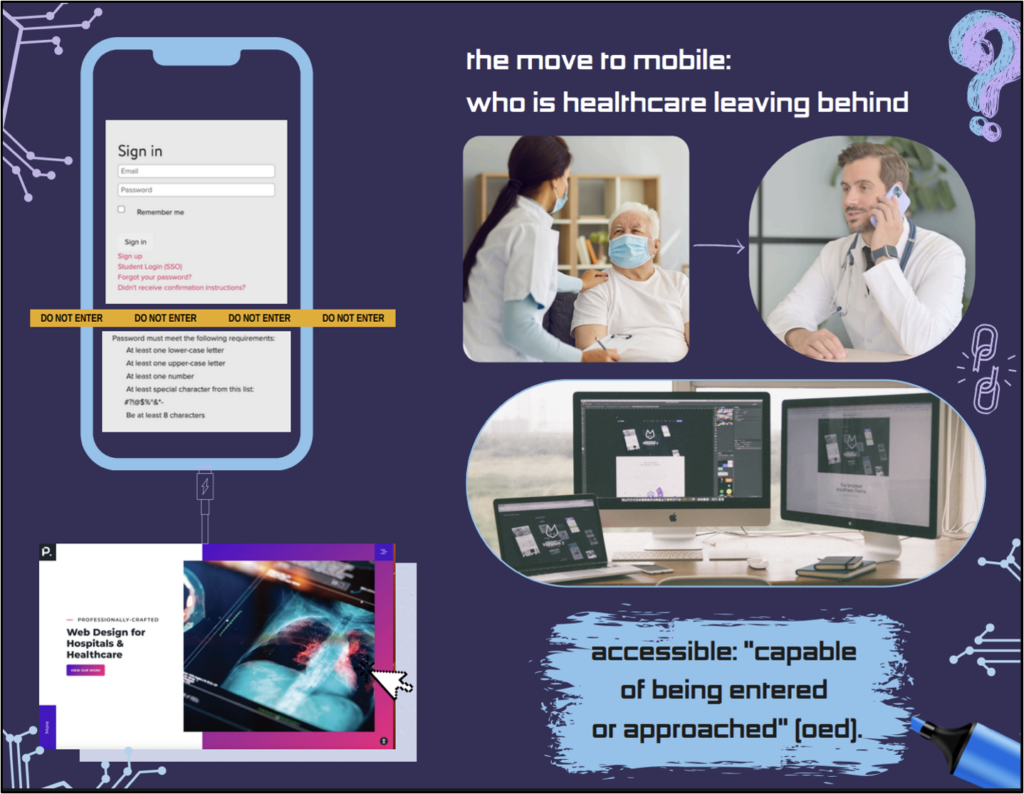
Once I determined my topic, it was time for me to begin the pitch and pitch card. This portion of this assignment required us to present our ideas to the class in a two-to-three-minute presentation, with the aid of a pitch card that was: a single slide, 90% visual, and purposefully avoided additional text. Creating the pitch card was daunting at first, since I was accustomed to PowerPoint presentations with many slides of text. I was able to come up with the 10% textual portion first, creating the working title “The Move to Mobile: Who is Healthcare Leaving Behind,” which I ended up keeping as the title to my final project (as seen in Figure 1). I also chose to define accessibility which both pointed to the importance of my argument and established my scholarly ethos, since this was the key area, I wanted to address within the genre of technical writing.
With the visual components, my goal was to communicate what the intended topic and audience was in a manner that my classmates could recognize quickly. Lambrecht et. al (2025) suggests that metaphor in their digital (virtual reality) story was able to save them time by prompting audiences with concepts that were already familiar to them. I ended up following a similar strategy, opting for colours that the peers I consulted and I associated with technology such as indigo and purple, a visual representation of a barrier in the form of a “do not cross” line placed across an image of a cellphone, and images of both technological devices and healthcare professionals in order to solidify the context I was working in, as shown in Figure 1. The pitch card and the pitch itself contained many images, quotes, and mini-scenarios (where I asked the audience to put themselves in a patient’s shoes) combined together, to illustrate the kind of story I wanted to tell.
The story I envisioned at the beginning of the term was one where viewers could hear many voices speak out against means of accessing healthcare that they found inaccessible, and it was the importance of having both multiple voices and advocating for accessibility that I wanted reflected in my initial pitch. Looking back at my pitch and pitch card, I see that it too was a form of storytelling: the journey I took to come up with this project and what I thought was valuable about this project being the story that I chose to tell. Here it is only me that was speaking to my classmates and professor, but I was telling the story with the help of a visual and the power of my spoken voice as well. When I got feedback from my peers, I was able to see that this is an effective method to tell my story, while also receiving feedback on my greater project.
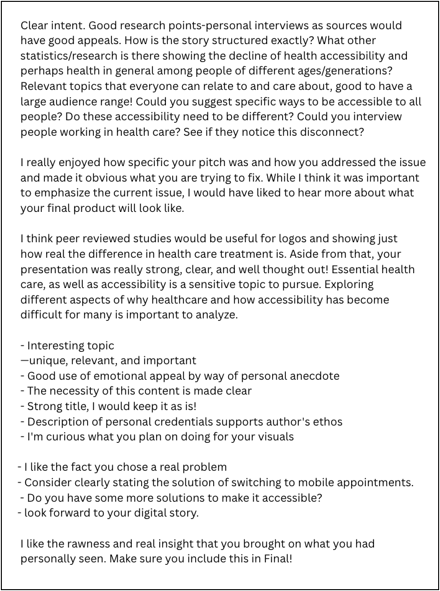
The feedback I received from students who watched my presentation demonstrated that they understood the situation I was portraying. They said they saw the value in my topic, as illustrated by the selected points of feedback found in Figure 2, where one peer said, “I like the fact that you chose a real problem,” another added, “good use of emotional appeal by way of personal anecdote,” and a third explained that they “like the rawness and real insight that you brought on what you had personally seen.” My classmates also understood that I was trying to create a professional piece informed by scholarship and asked informed questions such as “What other statistics/research is there showing the decline of health accessibility…?” I ended up implementing my peers’ advice in my subsequent touchstones and the final piece. I believe what helped them provide useful feedback to me was the fact that I used known associations so they could understand the story I was trying to tell in the manner that I intended.
Script and Storyboard
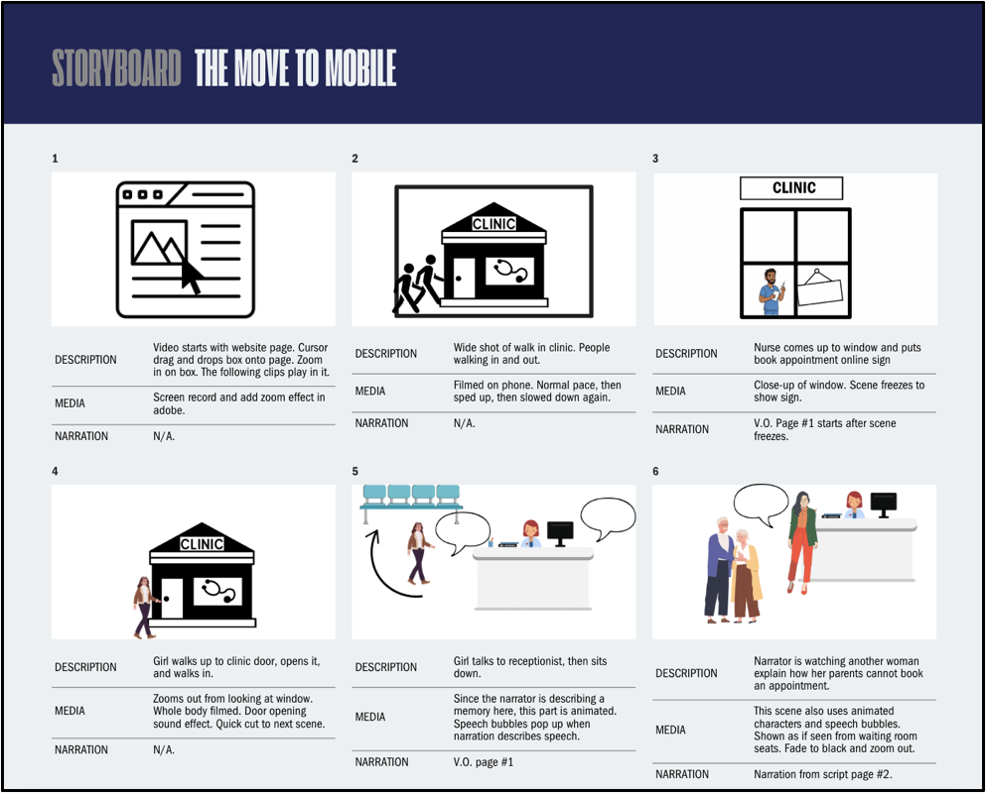
After receiving feedback and doing further research, I took my ideas and began arranging them in a script and storyboard, working to differentiate between the many voices in my story so that every voice stood out and mine did not speak over others. Sommers’ (2022) argues that TPC educators should demonstrate how narrative functions by teaching students to weave the stories they hear into their own work, ultimately illustrating the role that they play in the larger story. This project showed me exactly that. Out of respect for patients at the walk-in-clinic I did not film there. Instead, I weaved simple animations of what I saw which I constructed on Canva, news clips about my topic, videos of myself testing the usability of healthcare websites, and screenshots from both public online commentary and various scholarly sources. It was my goal to combine these elements in a way that portrays an accurate reflection of the problem and suggest potential solutions. As Carlson and Caretta (2021) suggest, TPC professionals should not only tell but also amplify stories of those who have experienced what we write about. In this project, I used scholarly sources to amplify the voices of those in the news clips and the elderly couple whose story originally inspired this piece.
Combining many voices to tell a story runs counter to the dominant approach of listening to a single story, which is the way many of us are taught. Instead of one person’s perspective, combining stories creates what Mangum (2021) calls a community of stories. He argues, “reframing storytelling toward a community of stories approach is needed to amplify marginalized voices” (Mangum 2021, p. 57). In my own project I compiled a community of stories by layering narratives of people affected by technological changes in healthcare in order to amplify voices that were not previously heard.
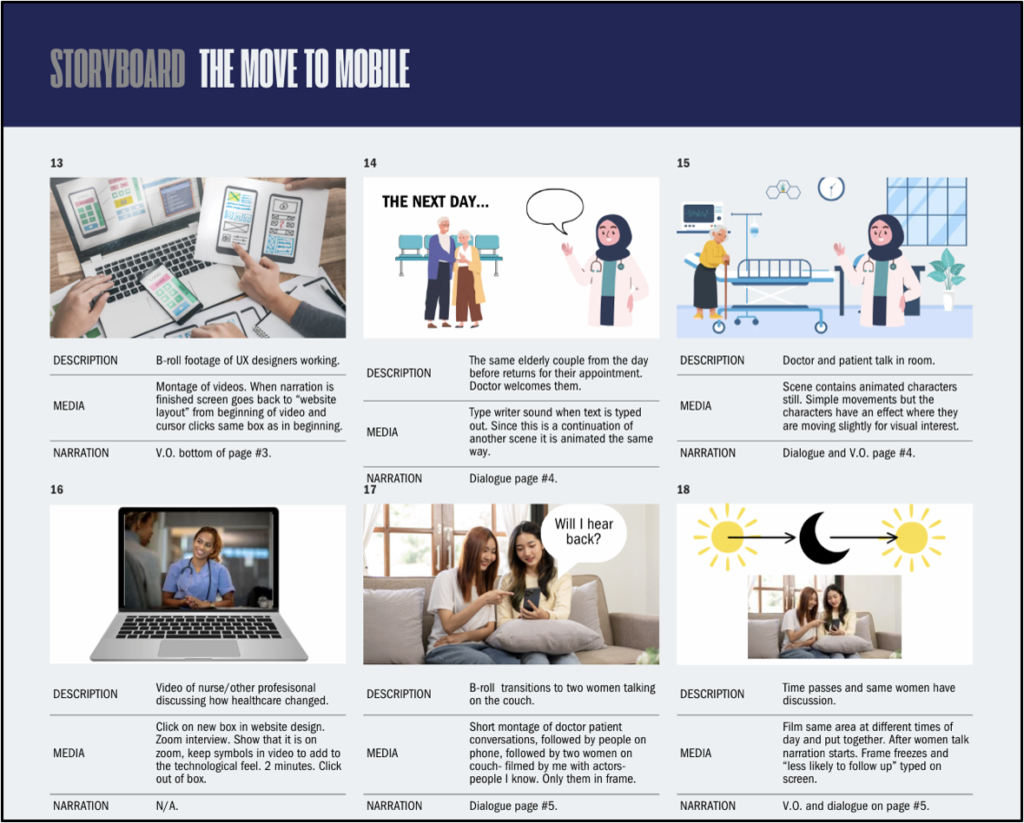
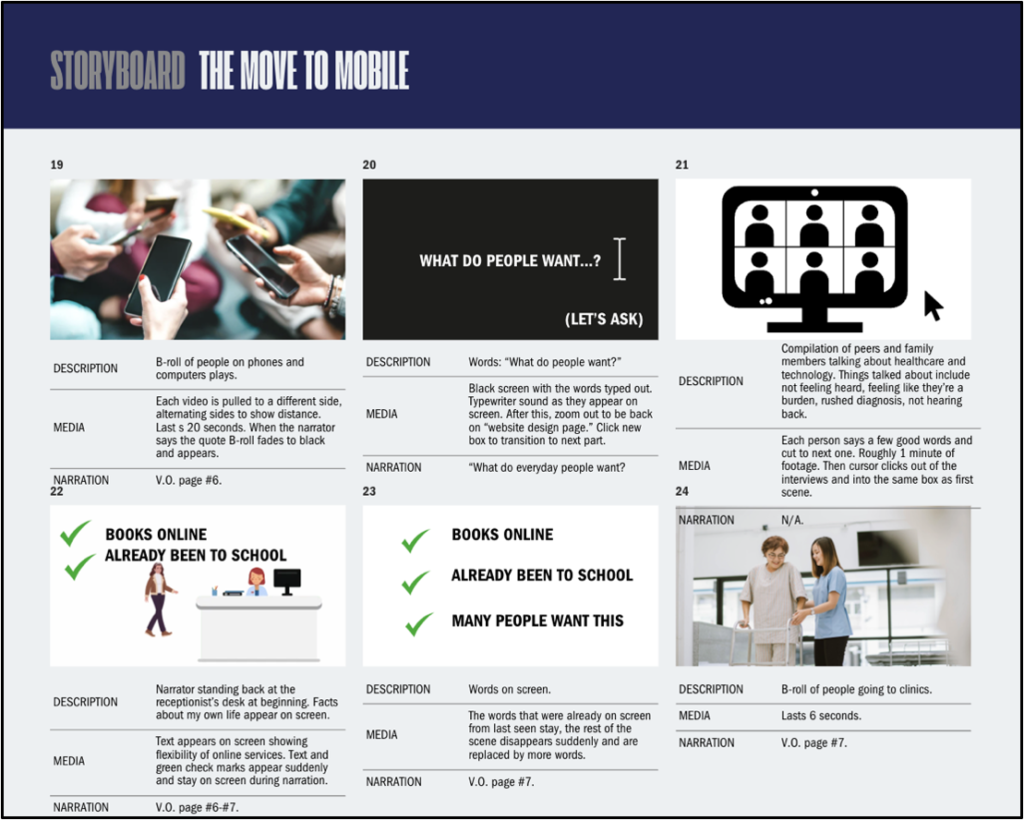
The process of combining these voices taught me about point of view. Point of view is, “the specific realization you, as an author, are trying to communicate within your story” (Lambert, 2003, p. 10). Since I was combining the stories of many others I had to be careful to portray what matters to them instead of simply using them as a means to prove my point. While my final video ended up looking slightly different, I began thinking about this while creating my storyboard. In my storyboard, I separated the stories of others from my narration by leaving their story the same as I heard it in the speech bubbles on the screen, as seen in figure 3, and using words like “I” in the script in order to distinguish my own experiences and perspective from that of others. I also made sure I included various perspectives, even if they were vastly different from each other. As seen in figure 3, I shared my own experiences, the experience of the couple, clips from professionals, and opinions from others around me (a section that ended up being a compilation of perspectives found online). In the end, I put together seemingly contradictory points to illustrate the importance of people being able to choose whether or not they use online services without it affecting the quality of care they receive. Layering stories and perspectives not only made a stronger case for my argument since it illustrated the full scope of this problem, but helped me to, as Sommers says, “tell stories truthfully and respectfully” (2022, p. 8).
Rough Cut and Final Video
Storytelling was not only a part of creating the pitch and final video, but also a part of the peer feedback process. Following the script and storyboard, we were asked to create a rough cut of our video and bring it to class, where we were divided in groups of four to five and provided feedback on each other’s drafts. While we took some notes to organize our thoughts, the instructions stated that feedback here was primarily discussion based. Here, the professor fell in line with Moore’s (2013) advocating for dialogue, as it shifts the discussion from data collection to storytelling, and allows us to hear what might have not been said in a more formal setting. Furthermore, Bacha (2018) argues that discussion and dialogue is essential to TPC as it can reveal why users like or dislike a product or technology. While our videos were not products or technologies, they were created for a certain audience, and receiving feedback helped us fulfill the expectations of those audiences just like we would have to do if we were creating a product. Receiving feedback through dialogue allowed us to tell stories about each other’s work, and illustrated what our audience’s natural reaction would be to our final products, while simultaneously allowing a freer exploration of these ideas than if we had provided written feedback or been given a more structured means of responding to one another.
The storytelling manner of providing feedback was indispensable to making my final video more accessible and audience-ready. In line with the requirements of this touchstone assignment, I initially asked my peers the following questions:
- What do you think about the animations? What can I add to them to keep them simple but visually engaging and help get my point across?
- I tried to use clips that are both reputable (like news sources which reference doctors) as well as those that just represent people. Is there a way I can better order the clips to help build ethos?
- How do you feel about the music choices? Do they work with the “feel” of the video?
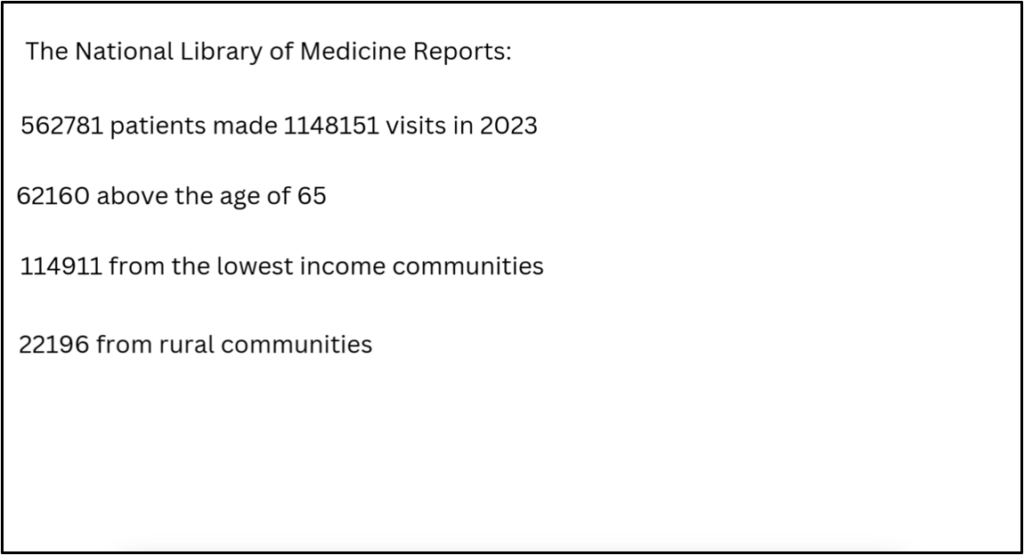
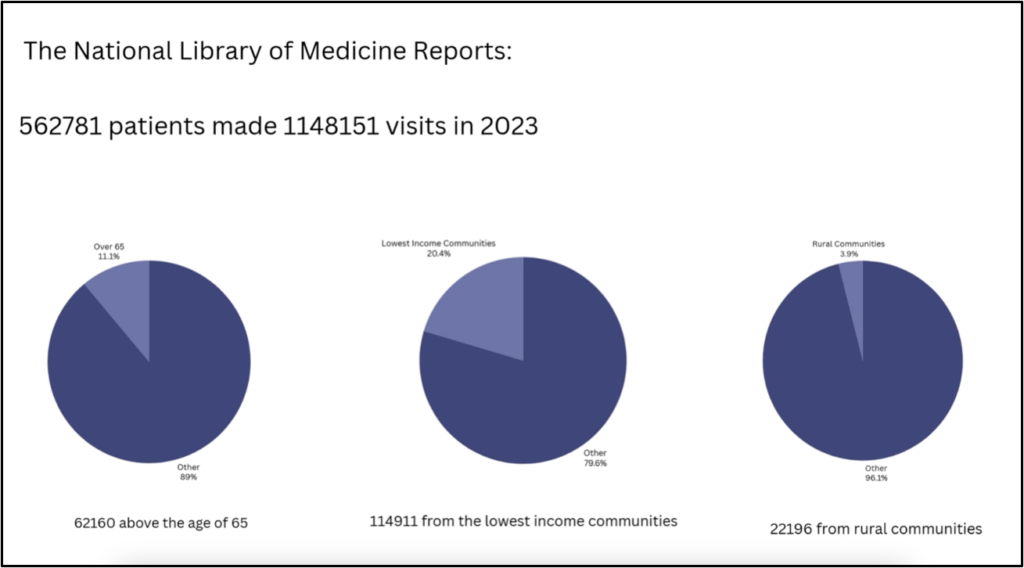
While I got answers to these questions, my peers and I started discussing different aspects of my project. I was initially worried about big-picture edits such as the feel of the video and the order of my assets, but my peers’ attention went to how I presented facts in one particular section of my rough cut. As shown in Figure 4, I initially had statistics from The National Library of Medicine written out on a white page with no visuals, but after discussing it one of my peers left a suggestion that I should instead portray the statistics visually, such as in a pie chart. I ended up taking their advice, which I agree tells the story in a more engaging and accessible manner. Without discussing this section with my peers, I may not have thought about changing this section and would have had a less audience-ready digital story, as well as harder to follow information due to a lack of visuals in my final project.
After the feedback session ended, the last few weeks of the class were spent working on the final cut. With the assets gathered and altered beforehand, my work consisted of ensuring my story was edited in a way that provided the audience with a cohesive antenarrative. Sommers (2022) explains that being a storyteller means learning to display information in a manner that is easier for audiences to understand, and with the many versions of the story that I have already told in the touchstones, along with the feedback from my peers in class, I felt confident to undergo the time-consuming but rewarding process of crafting the final video.
Overall Experience and Takeaways
Overall, this project taught me not only that narrative is a part of every step in TPC, from pitching an idea, exploring the situation one is working with, providing and receiving feedback, and telling your story to others; but that being conscious of narrative helps us better understand the skills necessary to become successful technical writers. This is because narrative prompts us to examine our own perspectives as well as consider other people involved. While there are many different types of narratives and the terms story and narrative carry different meanings to different people, one especially viable way to approach storytelling in TPC is through antenarrative. I found this method of storytelling to be conducive to the discovery process that is a part of TPC since I was able to gather more information from different voices rather than sticking solely to my own point of view. This meant I was able to more accurately reflect the issue, something that is essential for writing that creates meaningful change.
This project also taught me to reflect upon my own positionality, as well as the positionality of others when it came to telling and listening to stories around me. I learned this by exploring, as Moore, Jones, and Walton (2021) suggest, not only objective or provable stories but lived experience. While I did not go out into the world and conduct interviews, I was able to gather experience by listening to the stories of others in places I was already attending (such as the walk-in-clinic), and pairing those with video clips, online discussion boards, and scholarly articles to further portray the issue. I learned to navigate rhetorical situations and see relationships in the stories I heard (Moore, 2013), therefore becoming more comfortable with what Sommers calls “the complexities of narrative practices” (2022, p.2).
While this was a way for me to become familiar with the role of storytelling in TPC, one aspect of this project that made it harder to tell the stories of others is the fact that I was relying on my own authorship. I tried to get around this by leaving the mini-stories embedded in my larger story to speak on their own, and discussing my digital story with multiple peers. If I was doing this project on a larger scale, something that I would want to do is follow up with the individuals represented. Sommers (2022) says that In the TPC classroom, instructors can embrace the iterative process of making sure we are representing stories without talking over them by creating assignments that require co-creation. For this project I did a lot of co-creation with my peers, but the lesson I took away is that doing this kind of work requires constant communication and feedback, and this is the kind of work best done with the communities represented.
In the end, I believe learning how to tell stories truthfully and respectfully has the ability to make us more socially just communicators. While including narrative in one’s work does not automatically make them more conscious of the inequalities around them, telling stories changes how we perceive our work and the kinds of questions we ask (Cushman, 2015). This is an important skill for anyone anywhere, but it is especially important with digital storytelling due to the potential for digital content to impact a wide audience. Examining narrative in the TPC classroom helps students see the stories all around them, as well as the manner in which they tell their own stories. I believe the more students are exposed to stories whether it is through hearing the stories of others, or telling their own, the more they will learn to recognize stories in their workplace, and everyday lives.